Showing posts with label Rules. Show all posts

Wednesday, 6 January 2016

Painting table backlog


So what’s on the painting table at the start of 2016. 

At the front are a lot of 1/72 plastics from Hat. This time the WW1 East Africa sets they brought out about a year ago (and still waiting for the Brits!). 

The campaign in East Africa was the culmination of colonial madness with a number of European nations in Imperial conflict. Small armies ranging over immense distances on incredibly varied terrain transporting boats hundreds of miles overland to fight wars on lakes, armoured trains, killer bees, biplanes, a Zeppelin, sailors becoming soldiers, guns taken from battleships and pulled by hundreds of men through desert and jungle. What’s not to love (unless you were actually there of course).

The figures are going to get a basic block paint and a coat of dip. Shouldn’t take too long to sort a couple of hundred out.


 Pulling a motor torpedo boat through Africa by traction engine!


Armoured train(ish)


The main issue is a set of rules. I have purchased Contemptible Little Armies, If the Lord Spares Us (with East African variant), Crush the Kaiser and Triumph of the Will but none really grab me so I expect it may be a home spun set. The issue is that they need to be able to be played by at least half a dozen people, so not card driven, and simple enough to pick up once a year. The level will be about a brigade per side so Rapid Fire keeps shouting from the back of my head, a set we all know if not all love.

Thursday, 30 May 2013

Spring Projects

... any way HOTE was great fun and will be returned to. However DBA for the seven years war proved to be less successful. Too much back and forth to my eyes so it will be be a return to square one, which was a pretty fun square as I recall.

Enough of things square: the past few weeks have been a bit hectic at work, as well the Old Duchess turning 50, but I have squeezed in a couple of little projects a la wargame.

I have found that the only way to get painting is to decide to play a game for which I do not possess the figures. So in the four weeks between discussing to revisit Crossfire, the WW2 game guaranteed to give a headache, I had to get a battalion of French painted up to repel the damned Bosch.


Mostly Forged in Battle with Peter Pig I sloshed on the washes and good old Vallejo sepia shade.


At arms length, and with my myopic vision, they'll do a job, and of course won't be on table too long.


These guys show off their "suppressed" marker of which the French require an awful lot.


Needless to say the French did not do particularly well against their grey coated foe and were, in fact, well hammered. And yes the rules gave me a headache. Not because of their complexity for they are quite simple but, as it was for sergeant le Blanc in 1940, every decision is important and mistakes can mean disaster for one's platoon. Oh the stress of throwing a dice!

Secondly I have put away the squared board for the moment as the spring sunshine (ironic smile) has led me to clear out the old shed and I have erected a small but perfectly formed wargames table on which I can return to Fromagere in the not too distant future. A blast of trumpets and 21 gun salute!!!!!!!!!! Hurrah!!!


A range stick awaits the arrival of the Duc de Fromage.


Tuesday, 29 January 2013


Being a bit of a geek I spend a lot of daydreaming time wondering about wargame rules in the never ending search for the perfect set. I have been pondering again the rules for the wars of wine and cheese and for the coffee table squares. When not day dreaming I like to read about wargames and battles (like most of us).

Late spring of 1745 saw a couple of very interesting battles for the wargamer, Fontenoy and Hohendfreiburg. I was looking through Duffy’s “Frederick the Great – a military life” as Hohenfreidburg is the next battle in line for the coffee table series and then found myself skimming through “Wargaming in Hisory vol 2”; the chapter on Fontenoy.

One particularly interesting part of the Fontenoy is where the column of British & Hanoverian infantry have advanced and shattered the awaiting French infantry with devastating musketry and are charged by 30 squadrons of cavalry. The first line of horse is driven back by steady volleys and are replaced by a second line who in their turn charge and are driven back, some squadrons charging eight times to no avail.

I think my rules would probably reflect this giving steady infantry a definite advantage over cavalry charging head on.

 However a month later and much further east Lieutenant Chasot wrote of his experience with the Bayreuth Dragoons at Hohenfreidburg. “…we broke into a trot and finally a full gallop, putting our heads down and running into the Austrian grenadiers. They at first stood and delivered a volley at twenty paces, after which they were overthrown and mostly cut down.”

My rules would allow for this if the volley was ineffective but Duffy writes of the ensuing mayhem – “Behind the grenadiers the Bayreuth Dragoons collided with main force of the Austrian infantry.  In twenty minutes the regiment took five cannon, sixty seven colours and 2,500 prisoners, losing just 94 men in the process.”

Were the Bayreuth regiment so much better than the French at Fontenoy? Were the British just more effective at firing? Was it a matter of panic amongst the Austrians and how to reflect this possibility in a game.

It’s back to the palimpsest that are my rules to determine how to legislate for such differing results of cavalry charging infantry in the mid C18.

Sunday, 20 January 2013

Snow and sand

Just slipped and slided back from Birmingham Wargames Society.

Must be some sort of irony struggling through the snow after having played another excellent game with KISS Rommel rules in the western desert.

The Brits almost managed to win against the odds but the dashing Honeys couldn't destroy the supply dump before the 88s got 'em.

We really like these rules :

a) simple
b) fun
c) free

what more can you ask for?

Sunday, 6 January 2013

Chotositz 1742


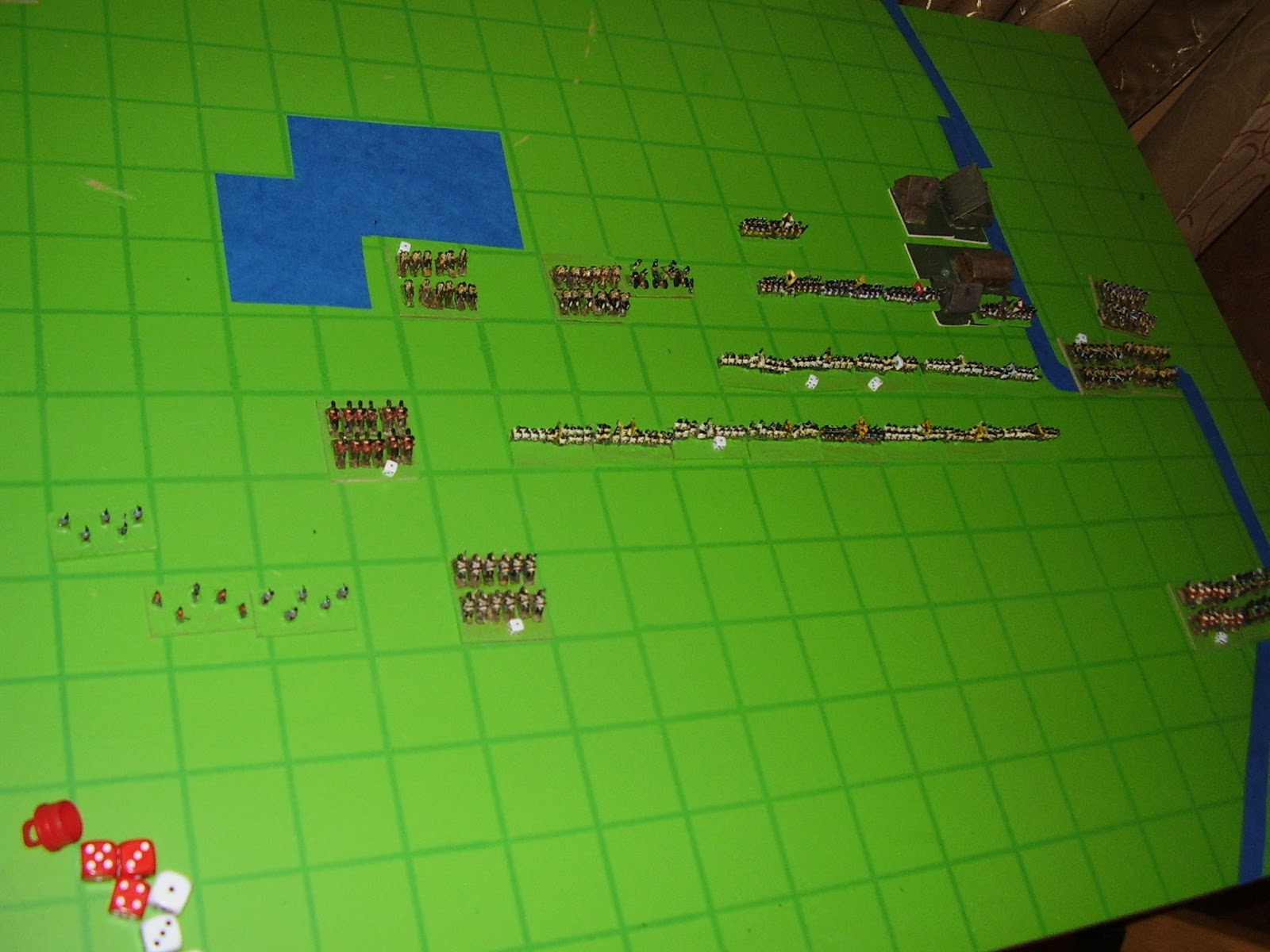
It was back to the rules drawing board for the Battle of Chotositz. I started with the premise of 3 and 3. Each unit has an attrition rate of 3 and would be allowed 3 dice for firing and/or melee. This will of course need some fine tuning, artillery for example gets 3 dice at close range, but 2 and 1 for medium and long ranges respectively. Elite units and cuirassiers may get an additional dice.


The whole Austrian army advance against the brigade of cavalry, lined up in front of Cirkwitz pond, and the five regiments of foot resting their flank on the town of Chotositz. Miniature dice placed on the unit base measures hits on the unit.


The aim of the Austrian commander, Charles of Lorraine, is to destroy what he believes to be an isolated Prussian army. Frederick however had broken camp early and was either racing to assist Prince Leopold or was waiting behind the curtains as the Austrians were enticed into an assault (depending on the source). Either way all the Prussians on table have to is hold on.

 Austrian cavalry on both wings charge.


Austrian cavalry charge into disordered Prussian as they cross the marshy stream


... and are repulsed by lucky dice.


On the opposite wing The Prussians lose a brigade of cuirassiers but the second repulses their opposition. The infantry take casualties from efficient musketry.

  
The cavalry battles rage on on the wings but the Austrians exchange fire when they ought to be charging home.


 The white coats numbers begin to tell but they can't break into the village.


However by move 7 the Prussians are reinforced by a slightly tardy Frederick and their position in untenable.
These embryonic rules gave a more satisfying game than the previous DBA style but the casualty marker dice are both too fiddly and too unsightly. Some sort of marker is required.

Saturday, 1 December 2012

Sounds familiar

I spent quite a bit of my spare time thinking about the Portable Wargames Rules for the C18 and came up with what I thought was quite a nice set.

However when I read through them again they seemed quite familiar. Yep I had almost managed to rewrite Twilight of the Sun King. We had a look at these a while ago using the free set available on Steve's Balagan (but nothing came of it and we stuck with Volley and Bayonet). They must have remained in my subconscious.

The free set are still here:

http://www.balagan.org.uk/

There is however a more recent iteration available from The Pike and Shot Society. I ordered these for the princely sum of £3.45 (inc p&p). They arrived the next day - excellent service. 

At this price you don't get a Black Powder type book, more like the basic rule books of old. They are a grand tactical set of rules based on the brigade - 1cm =100 paces with combat resolution based on a simple morale test. With a couple of tweaks for the grid system they should make a quick game. 

And, if you like that sort of thing, there is an active Yahoo group.

Wednesday, 21 November 2012

PWG AoE part trois

Had a quick go at the PWG C18 rules I mentioned last time. Starting at the beginning of Prof Duffy's maps I had a go at a version of Mollwitz, with various levels of success.

The first quandary was whether to add in some national characteristics. In the end I did as I thought it was the essence of Mollwitz and I made all Austrian cavalry elite and their infantry poor.

The armies were almost equal in  numbers of bases, Austrian 18 to Prussian 19. However the Austrians had eight cavalry brigades to the Prussians four, whilst the Prussians had the only battery.


I really need to create some suitable terrain!


Action started, as in the battle, with an Austrian cavalry charge and due to the national trait weighting their cuirassiers immediately routed a Prussian dragoon brigade.


The other dragoon base held it's own and all brigades fell back. The Prussian move had advanced the first line of foot and swung round the second to protect the flanks.

On the other flank the Austrian horse formed one long line outflanking the enemy.


The second rank of Austrian horse assault the infantry.


While the first rank follow up on the Prussian dragoons.


The second rank dragoons lose a unit to infantry fire whilst the brave dragoons live to fight another round.


On the Prussian left the Austrians charge in.


Again the infantry destroy the assaulting cavalry but both Prussian cavalry units are routed. An Austrian dragoon unit extricates from the melee and charges into the exposed flank of the Prussian foot.


Inexorably the Prussian foot advance into contact with the Austrian foot. The artillery has bounded forward with the infantry but have not been able to fire and move as they actually did. Now they have contacted the enemy they may fire in close combat ie cannister range. On the flank the cavalry fail to break the flank.


In a couple of moves the Prussian infantry over power the Austrians and the game is over as the Austrians fall to half strength.

It didn't take long to set up and from move one to the end it took about half an hour to play. Quicker than I wanted. I think I can add a little more than Okay/Disordered/Destroyed ie some sort of unit points strength to give a bit more "flavour" to stretch the game to an hour.

The "national characteristics" effectively made the result a foregone conclusion ie a refight of Mollwitz and I don't think I shall be that blatant again.

The artillery wasn't given a real test as there was only one battery. One point is that Prof Duffy describes the artillery as bounding forward with the Prussian infantry. These rules don't allow a battery to fire and move. What Duffy doesn't say is how effective the artillery was whilst it moved forward. If the effect was negligible then the rules are correct ie the guns may be firing but not effectively enough to merit a dice.Something to consider.


Monday, 12 November 2012


The Portable Wargame in the Age of Enlightenment

Aims – a quick, preferably one hour, game on a small(ish) board with an C18 feel to recreate the actual battles of Frederick the Great. So one base = one regiment of foot possible one brigade of horse.

Simplistic assumptions – infantry would probably stop frontal assaults by cavalry but if it didn’t it would be ridden down. Attacks on the flanks would be advantageous to the attacker. Artillery was not good enough to destroy enemy units beyond canister range but could disrupt enemy attacks and soften up the enemy as a prelude to attacking. Musketry was only decisive at very close ranges. Movement stately but not ponderous. Skirmishers had little influence on the result of most "large" battles in Europe.

Ideas – close combat will include musketry therefore no small arms fire phase. No use of rosters, removal of whole units when routed – therefore some use of markers. However a unit would have a marker or not, only as an indication of it’s order, not a build up of markers as attrition; to make it easier and quicker. Disordered units would be penalized in movement and combat but would be able to rally off their marker.

We have used some of these ideas in a number of iterations of our home spun rules in the last few years so it proved just a matter of paring these down. It's whether this distillation proves to be too simplistic.


So the first draft looks like:


1. Simultaneous Artillery Bombardment          Range: 5 squares.

i) All ranges are measured through the edges of the grid areas not the corners (see appendix).

ii) Roll one dice per battery firing hitting on 5 or 6. (targets in cover, artillery or skirmishers may try to save their hits).  Units hit are disordered, if a disordered unit is hit again it is routed.

iii) A disordered battery may not fire

iv) Batteries may not fire over other units or high terrain features unless on a higher contour.

v) Batteries may not fire at bases in the square directly to it’s front as this is Close Combat.
vi) A battery may not move if it has fired – mark it with smoke as a reminder.
vii) A battery may be counted in close combat if it has fired or moved.

2. Movement    (Either by initiative, leader, nation or in turn)
  Infantry            Artillery      Light Infantry       Cavalry       Light Horse                   
 3 squares               2                 4                      5                      6
i) All movement is measured through the edges of the grid areas not the corners ie no diagonal movement.
ii) A change of facing costs one square of movement but a unit may wheel forwards (not backwards).
    without it counting as a separate facing change. Light infantry may change face without penalty.
iii) A unit may not enter a square that an enemy is facing unless it intends to fight it.
iv) Cavalry may not contact an enemy unit that is in a terrain feature the cavalry could not enter.
v) Disordered units may not move
vi) Units in contact may not move.
vii) Only unit is allowed in a square, A unit must face one side of the square it cannot be diagonal

4 Rally: disordered units not in contact may rally away their disorder.

5. Close Combat (Player with initiative may choose order of CC)
A unit that faces, or is faced by, an enemy base in an adjacent square is in close combat.
Both sides each throw a D6 and adjust the score accordingly. Artillery contacted on a non firing side has no dice.
Support may be given by friends (not in contact with another enemy base) that are in a square facing the enemy square or are at the side of the base in contact facing the same way.  A unit that is contacted in the side is immediately disordered.
Amend the dice throw:       Per Supporting unit   +1        Disordered       -1            Defending cover             +1     Light troops            -1         Elite        +1        Undisordered infantry v mounted +1

Outcomes         Loser began CC Fresh                         Loser began CC Disordered
Drawn combats:                All mounted will withdraw otherwise remain in contact
Difference of 1 or 2                             
Artillery in contact                                       Routed                                      Routed
Infantry losing to Cavalry                              Routed                                      Routed
Others                                                  Withdraw Disordered                        Routed
Difference of  3 +                                       Routed                                      Routed                         

Winning cavalry may halt, advance one square or withdraw. Cavalry hitting another unit may close combat again but will must withdraw disordered, on conclusion, even it wins.
Winning infantry may only move forward to enter cover it has assaulted otherwise stays put. It may not fight again.

Terrain Moving through streams or fords in river costs two squares. A non skirmish unit will be disordered whilst in and on exiting the water.  Artillery may not cross streams nor enter closed terrain and if deployed in it initially may not move. Cavalry may not enter woods or villages other than by road and may not contact an enemy in such cover. Other woods may be deemed closed or open to regular infantry. Ordered infantry will be disordered on exiting woods.

Withdraw - means move one square directly back away from the threat – not diagonally.  A unit that cannot withdraw because there is an impassable terrain feature or the square is already occupied is removed.
Routed  - means removed from the board

Securing a flank. Infantry may secure a flank by placing a friend at right angles to a flank, facing away.


Wednesday, 31 October 2012

Winter plans

It's been a productive few months and I've started and completed the British Empire half of the  KISS Rommel project in about eight weeks. (As expected Richard completed his half too). We had our first game at the weekend and it was excellent. Seven of us played using rules none of us had played before and five hadn't even read. We fought a fun and tense game to it's conclusion in about three and a half hours. A minor British victory too.

I have been reading with great interest Mr Cordery's Portable Wargame project. 

http://wargamingmiscellany.blogspot.co.uk/

 My games at home are dependent upon the dining table, not the most practical solution when it also needs to be used for homework, sewing, drawing and even dining.

I have had a quick go at the portable wargame using a chess board and had a bit of fun with it but felt constrained. The idea is intriguing and no doubt the shed will offer up a larger piece of mdf I can draw a few more squares on.  A two foot square "table" would give 15 by 15 squares of 40mm. This would fit nicely on the coffee table in front of my comfy chair or even on my lap. This could keep me going through the long winter nights.


Monday, 1 October 2012

A few other things..

Only just noticed the time lag between the last two posts  - well over two months! 

Sadly nothing has happened in the Wine and Cheese campaign but I have been busy with other projects.

I have painted a division of 10mm Turks for the Crimea (I have no idea how I fell for that one). We had a cracking game on Sunday, but sadly no pictures. We used Black Powder but may try a Fire & Fury variant next time

Also I have furtled up a Nine Years War army that has been languishing in the attic for years.

A long time ago we bought quite a few painted Dixons from a bring and buy. I tried to touch up the poor old veterans but when I sprayed them with matt varnish I got the dreaded white powder finish. Probably due to atmospheric conditions. Into the attic they went. However when I was browsing TMP I came across a potential solution. Simple paint them with gloss varnish. And it only worked. 


I quite like the shiny look

I have based them up intending to use Baroque Impetus rules.


Finally I am working on a 6mm desert war British army c1941. I am not a great fan of WW2 due mostly to the complex nature of the rules, and lack of tricorns, but Richard has discovered KISS Rommel. A relatively old set resurrected by freewargamesrules. They look very simple and include a nice campaign system as well.

So that's what's on the bench in castle vallejo for October.


These Honeys will instil fear into the D.A.K., possibly.

Wednesday, 25 January 2012

Charge meets Blackpowder

Being of a sad disposition I tend to find myself reading wargames rules for fun. I seem to have aquired dozens over the years.

A month ago I had a couple of thoughts about introducing morale tests to my Charge games. So when I was perusing Blackpowder last night it became apparent that that the 50% rule in Charge might be considered the same point as Shaken occurs in Black Powder ie the moment of crisis when the unit must be tested to see whether is breaks.

Not a 100% sure where this is going but my initial thoughts are that a) a unit takes no more casualties beyond 50% or rather they are not removed but count towards a morale test, b) a "break" test at this point would give a little more unpredictability to Charge.

Time for a snifter and more thought.

Sunday, 18 December 2011

Rules & BWS

I have been writing up our games at Birmingham Wargames Society on this blog whilst other reports have appeared elsewhere. So BWS have a new blog site where we can consolidate our wargaming story - please follow the link if interested.

The intention is keep this blog for my attempt at creating the world of wine and cheese which I can hopefully (re) kick start over the forthcoming holiday period.

Firstly which rules:

As with many imagineers I started this project with the intention of using the seminal Charge! rules (Young & Lawford) that first revealed to me that playing with toy soldiers didn’t have to end with junior school. A joy just to read but also a simple, fun and subtle set of rules for horse foot and guns.

There is of course a “but” or two about to follow.

Firstly while I love the look of individually based figures it does lead to a lot of messing about. Unfortunately I do not have a permanent wargame space and need to get games over and packed away in less than three hours. I get the impression that the Brigadier may have spent a day or two over his games. Also I am using the lovely Zvezda plastics which even when based on thin steel have a propensity to fall over if the table is nudged.

So the figures are now based up in eights (a firing platoon in Charge). This, of course, leads to the predicament of removing individual figures which I have solved with the use of steel bases and magnetic sheet. Gluing the front rank down and having the second rank on magnetic sheet. Choosing the simple Old Wargames approach of painted bases this doesn’t present too much of an issue. In fact painting the bases the same colour as the wargames table (Wittenburg green) means that you can’t really tell they’re on bases at all. The steel bases do slide easily across the painted MDF too. This does mean that officers and Nco are included in the unit total.

However there is of course the issue of individual cavalry melees. These can be fun but big fights can take an inordinate amount of time. I have therefore decided on new cavalry melee rules based on the old Wargames Holiday Centre Marlburian rules published in a magazine in the early 90’s. Essentially throwing a dice per figure in the front rank and determining total hits from a predetermined number.

Another thing that gives me headaches is the half and halve again after some firing. So while I intend to keep the half casualties at long range I shall adopt the “save” on top half of the dice for targets requiring half effect such as cavalry. While this will balance out over a game it can give more varied results.

Then there is the issue of morale. While the rules as written have the morale built in with regards casualties lost, the use of the 50% rule (ie a unit is fine at 51% but not at 49%) does mean that the point at which a unit will withdraw can, sometimes, be easily judged. Also, following a melee the loser will withdraw, very civilized but I would prefer an option to rout too. Finally one point I don’t like is that a charge cannot be stopped by fire. It can lead to a situation where a cavalry charge on an infantry unit can take a lot of punishment going in and get well beaten in melee and still leave the infantry in a disordered state that has to withdraw. There are many examples of cavalry being stopped short by steady volleys.

So, I’m going to try out the following morale tests. Firstly for units whose losses exceed 50% a dice throw (following firing) less casualties taken above half the original unit strength, a resulting score of 0 or less means withdraw as per rules, a pass allows the unit to carry on. Secondly for units charging in a couple of dice thrown less casualties taken during the charge a resulting score of 0 or less means withdraw before contact. Finally a throw of one or two dice for the loser (one if understrength) less the difference in melee casualties: a resulting score of 0 or less means rout otherwise withdraw as per the rules.

Hopefully I’ll be able to give these a whirl over Christmas. Calls for port and stilton methinks.