Showing posts with label The American War. Show all posts

Sunday, 13 March 2011

WMMS Alumwell 2011


A quick trip to Wolverhampton today for the Alumwell show where I managed to restrain my spending to a few paints and a box of Zvezda Black Hussars. And some grassy tufts, And a box of Perry ACW infantry. And some matt varnish. Mmmmm not as restrained as I ought to have been.
Shows ain't what they used to be but still nice to go and see a few games and perhaps get some new ideas and spend some dough without p&p. A few piccies below of the very nice AWI game that fellow Birmingham wargamers Jim and Tony put on.


Saturday, 14 August 2010

Belated Piccies

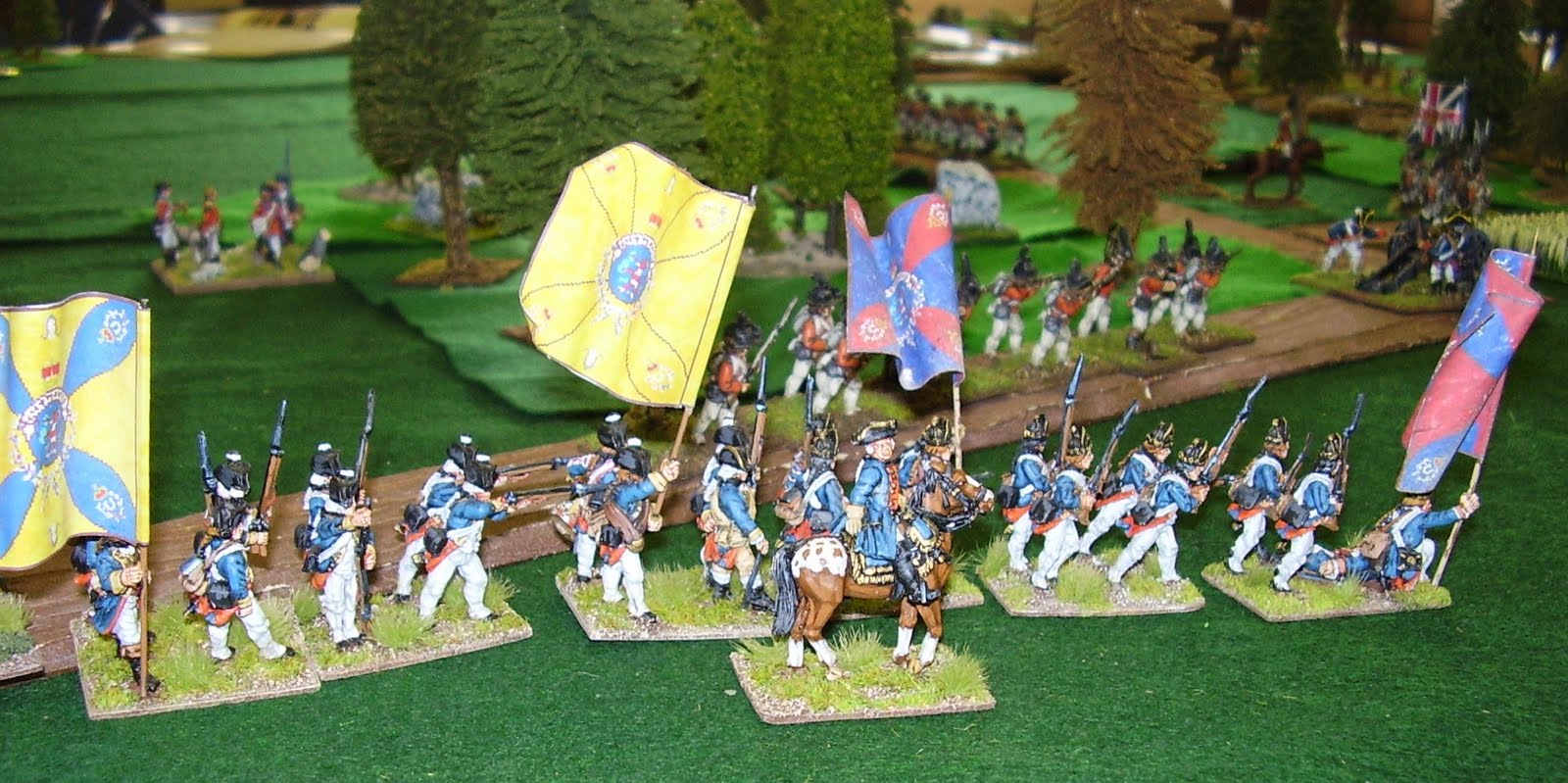
A few belated piccies from AWI Blackpowder game (thanks Ade)

Awaiting the redcoats arrival.


The American Second Line take up position


"Down with King George"

They may not be able to shoot very well but they're damned good at fencing.


American skirmishers skulking in woods.


American Second Line falls back


British press forward.


Continentals defend the town


......and the road


Friday, 30 July 2010

Black Powder III

.... and the irony is that we have the prettiest table ever and I forget the camera.

Imagine a verdant green sward of teddy bear fur
, bespoked clumps of birch and beech, snake fences, rocky outcrops, cornfields and a delightful Virginia town.

With a scenario loosely based on Guilford Courthouse the British/German force consisted of a dozen line and guard batallions, a couple of cannon and four skirmish units including one of injuns. These were divided into four brigades. Two in the first line and two immediately behind.

The American force was fifty percent larger and had the advantage of three distinct defensive lines including the ultimate goal of the town. However twelve of the rebel units were militia with poor or very poor morale.

We began with a brigade of North Carolina Militia, of four units, behind a snake fence a couple of feet from the British end of the eight foot table. British skirmishers began in range of the yankees (8" using the 2/3 movement scale). The Militia's opening fire was poor - having no effect upon the redcoats. On the British turn the majority of the advance brigades moved into long range and opened fire, adding a dice for first volley. A half a dozen hits - all but one saved by the lucky militia! With the militia's poor morale they required sixes to save; it must be noted that this was done with Adrian's blue dice (and we all thought they had no sixes on them).

On the right the Hessian's were finding it difficult to move forward but a British cannon laid low a regiment of mounted dragoons with one fine salvo of grape and the unit of indians was sent through the woods to outflank the second American Line. Their "bloodthirsty" bonus was used to good effect and they broke a militia batallion.

On the left the second British brigade were advancing smartly forward towards the second line of militia and were hit by a smart volley at long range by Kirwoods riflemen. A valiant charge however broke though the militia and the belt of wood and scrub into the open ground before the town. Similarly on the right the British-Hessian brigades proved too strong for the Virginians and they fell back towards the town to form a new line behind redoubts

However now the government forces were facing the cream of Greene's army, Maryland and Virginia Continentals. Firefights, charge and countercharge ensued but no breakthrough was made before we had to call it a day and the damned rebels claimed victory as they still held the town and pike road.

The first line of militia had proved very obstinate and while it was inevitable that they would break, the four moves it took cost the British too much time and while they were still relatively fresh at the end of the game the Continentals too had plenty of fight left in them.

Had we had time to continue for a couple or three more moves any victory would have been pyrrhic. A true reflection of 1781 when Cornwallis's tactical victory ultimately cost him his army.

Today's cheese was Jervaulx.

Sunday, 4 July 2010

Battle of Freeman's Farm


Washington ponders the news that the British are a coming.


Another attempt at the Black Powder rules.

We took the scenario from the Black Powder book but as we were using half size units
we adopted the 2/3 movement and range play sheet (thanks Jeff).

The British/German army had a couple more battalions than the Rebels and also four guns whilst the American's had none. Moreover the British troops were deemed to be "steady" and "crack", effectively enhanced morale.


Initial dispositions had the first British brigade (Hamilton's) marching along the road and a picket were wandering over to have a peek at the farm and woods. No pesky rebels in sight. The Brits get to move first, in theory, as a throw of 11 on Command prevents Hamilton's brigade from moving. The second Brigade however marches onto the table and along the road. The picket is (not very) surprised to be fired on from the woods as Morgan's brigade reveal themselves.


(piccies look better when enlarged than shown here)

With an excellent Command throw Poor's Brigade of Rebels advance between the farm and woods to Morgan's left hoping to reach the stream before the British.


The second British Brigade, Fraser's, enter the table in column of march with a skirmish line of injuns covering their right. In the centre the pickets engage Morgan's brigade in a long range firefight and Hamilton manages to bring one battalion forward before another Command failure.

Fraser manages to advance (slowly) on the right but in the centre Hamilton manages to turn column into line but then fails to advance following two Command Failures. The Yanks however pour forth along woodland paths and find an excellent defensive position with stream in front and between woods and farm.


Eventually the Germans arrive following Fraser along the road. Two excellent command throws see them in line and pouring fire into the rebels while the British continue with poor Command throws and struggle into battle line. The Picket and the lone batallion in the firefight with the American right are routed but the Americans hold their line.


The Americans have an excellent defensive position behind the stream and although this deters the charge with cold steel the British/ German firepower enhanced with artillery is proving superior. The "steady" and "crack" rules prove invaluable to the Brits in the firefight. Eventually the poor morale of the Americans begins to tell and they begin to withdraw.

Regimental mascot assists in British interrogation of a captured rebel.


The result was pretty much as that played out by the authors of the rule book and given the breakdown of the armies seems alomost inevitable. Given the poor Command thorws of the Brits more agressive tactics could have paid off for the Americans. However given the poorer troop morale levels and the excellent defensive position on offer it would have been a very brave and fortunate commander who could beat the British in this scenario.

Regimental mascot eats colonel's tricorn!


Washington ponders defeat with faithful friend.

The game started off quite slowly as we tried to get to grips with the rules again. While they are a good read they are not the easiest to pick out the relevant bits.
I want to like these rules but I'm not yet sure if we'll persevere. As players we make enough mistakes so do we need to be slowed down even more with Command rules. The argument is that this is realistic. Firstly how realistic is it that a brigade of professional British soldiers of 1777 would not be able to deploy in time to participate in a fight with rebels a few hundred yards away. The fact that we all know an example or two proves how rare this was. Secondly I play for fun not for a faithful reenactment of warfare.
Otherwise I like the mechanics of the rules and if we used them more then I think we would get used to the special rules such as "crack", "steady", "marauders", "blodthirsty", etc etc.
The self inflicted problem is that we never play the same rules two games running and rarely play the same rules two or three times a year. This tends to mean we go for the simple rather than the detailed. Mmmmm watch this space.
Todays cheese was Vignotte.

Monday, 8 March 2010

1780 - Black Powder


Had a first look at the new rules from Warlord (courtesy of Generaljimbo) this weekend and even got some American War of Independence figures on the table. As with all new rules the first moves were a bit slow as we got to grips with the mechanics. Probably more a reflection of our brains than the rules.


The rule book is a splendid production with lots of lovely piccies in it but is a bit expensive at £30.00. The game mechanics are relatively simple but were not loved by all. The main bone of contention being the command and control rules based, I think, on the Warmaster system. Are they a requirement in a game or not? I think they add to the realism but can lead to a slow game for individuals in a multi player game. Undoubtedly we make enough mistakes on our own not to need them. The mechanism here is a bit strange due the use of two D6 determining actions slightly altering the odds from what might be expected, the use of a twelve sided die might be better.

One aspect I particularly liked was giving verbal orders to a unit. “The regiment will advance in column along the road and form line at the edge of the road.” Naturally they were a bit slower than anticipated. I need to be more authoritative.


Anyhoo the scenario of The Battle for Ashland Ferry began with a mixed brigade of British grenadiers, light troops, rangers and a gun holding the town and ferry. Naturally the rebels needed to capture the aforementioned and began to enter the table on move one along two roads. Being forced to be in road column a round from the light battery did quite a bit of damage on a militia unit as it marched along. Once on table the command and control mechanism kicked in with one brigade unmoving on the hill and another unable to shake out of road column. As the redcoats entered from the opposite side further artillery fire put paid to a Maryland regiment.


Light Dragoons lead the redcoats out of the woods.


Marylanders guard the pub.


The New Yorkers eventually find their way down the hill.

Due to further poor dice throws both the British supporting brigade and a Hessian brigade began to picnic in the woods rather than advance to meet their foe. The light dragoons being lost to long range fire before being able to charge.


The token French brigade proved much more able to throw low and as if on manoeuvres marched forth and into line very nicely. By the time the Hessian managed to emerge from the undergrowth the French were there to meet them and being caught in column of march (a bit of a theme seems to be emerging here) the Hessians took quite a beating. A squadron of hussars enjoyed the German confusion and taking out one unit proceeded to hit another in the flank. Much to the chagrin of Jim all hits were actually saved and the Hessian survived.


Hessians advance in column


...and are caught by the French.

French Hussars threaten the Hessians.


In the centre the Americans eventually got moving and charged into the grenadiers holding the hedge (lack of fences in the terrain cupboard) and after a prolonged melee even the strength of the grenadiers failed against overwhelming odds.


Despite the assistance of a large green ball the grenadiers fail to hold the centre.

As far as the group is concerned the jury is still out with regards the use of Black Powder. Personally I liked them and would persevere with them. They are very open to tweeking, in fact the authors suggest it. For our small units perhaps reduced movement and ranges might be beneficial. (a full move could be 36” for foot!) whilst long range fire is 18". Also I would reflect the better control of “professional” soldiers over militia, but having redcoats I would say that.


Todays cheeses were Little Derby and Shropshire Blue. (I am assured from a dairy in Shropshire).


Wednesday, 27 January 2010

The Butler did it!


Yet again the bane of the wargamer stalks Castle Vallejo. Project dispersion!!!

January has seen no recruitment to the imagiNation armies, too cold for the press gangs of Colonel Boursain no doubt.

Instead an old club project has raised it's head in the form of 28mm American War of Independence.

Many years ago we started this and it petered out due to a lack of rules we liked. However we going to try again, possibly using Will's AWI rules from freewargamerules or even a variant of Volley and Bayonet.

Either way it's splitting out the old twenty man units into twelves, not a natural division.

As always some bare lead turned up in the dungeons (ie a box in the shed) and I have sploshed some paint on it to give me a unit of Butlers Rangers. Not the prettiest unit in the world but no doubt will throw just as many dice as their more attractive enemies. Co-inkadinkally there were eighteen figures in the box giving a formed unit of twelve and a skirmish unit of six. Serendipitous.

I calculate this will be our tenth "tricorn" project in all conflicts and scales. Is this confirmation that the C18 is the "best" period for the wargamer?

Sunday, 22 November 2009

Bunker Hill (again and again)

Unfortunately my camera has gone awol so no piccies of a fun afternoon with Birmingham Wargamers.

General Jimbo set up a very nice interpretation of Bunker Hill terrain so with 15mm armies and a set of Volley and Bayonet we set about changing history.

We began the first game at 14:45. The main force of red coated Brits advanced manfully through the disordering terrain ignoring the inaccurate fire of the light guns in the redoubt. The British grenadiers and light troops moved around the flank of hill.

14:55 hours - two British regiments assault the corner of the redoubt to bring two line units against one militia. With a morale rating of 5 only a throw of 6 could fail; of course Jim throws two 6s. With sterling defensive throws against the now disordered red coats the initial attack is repulsed. On the rebels' left the fire of the Grenadiers and light troops prove ineffectual. The militia however prove to be good marksman and the Grenadiers take casulaties.

15:00 hours - two more British regiments charge forward to assault the redoubt, only a throw of 6 on their morale test could prevent a break in on the redoubt - Jim throws... two sixes. The melee goes with the yankees and two more red coated regiments are routed. Derisive laughter can be heard from behind the breastwork. The grenadiers also charge and push back one of the brave colonial units but do not break them.

15:10 hours - An heroic militia regiment charges into the flank of the Grenadiers and with musketry support destroy the already weakened Brits

15:15 hours - Game Over

At this point we usually set up again and swap sides - however Richard and Jim are determined to reverse the embarrassing performance. Red Coats and Red Faces.

Always funny to see four consecutive morale failures. Quote of the day paraphrased from Dame Edna; "God has given me the gift of laughter ... at other peoples' misfortune."

The next game lasted a little longer as the Brits manoeuvred onto the flanks and blasted the poor colonials with well aimed musketry and long range artillery before charging in. Even the rebels gave a good account themselves before being overrun.

We agreed to swap sides for the third and final game.This led to much manoeuvering and hanging about by the Brits who hoped for better results from a thin skirmish line and a couple of cannon. Eventually a charge from one side of the redoubt managed to rout the weak and weakened militia. Equilibrium was restored.

Today's cheese was a very tasty Caerphilly.