Tuesday, 31 August 2010

BlackPowder IV: Relief of El Tel


The Sudan of the 1880's is an interesting period of history and should provide the basis for a good wargame what with colonial brits in red and grey and marine blue, with camels thrown in for good measure. The odd Egyptian unit, some armoured, and a variety of colourful natives that proved more than capable of holding their own, until the arrival of Mr Maxim's baby. Then there's the Nile with improvised and purpose built gun boats and the option to add a unit or two of French to add flavour.

For those who like to add characters to their scenario then no fiction can equal Gordon, Kitchener and, being the Birmingham Wargames Society, our own Colonel Burnaby.

We've tried Peter Pigs PITS rules and some house grown rules but never had a completely satisfactory game. So as Black Powder has been at the front of our wargame thoughts and the book has some very nice piccies of a Sudan game - "why not?"

The answer should have been "because we don't have enough figures." But a quick note to Mr Pig and couple of weeks frantic painting and another few units were added.


'Eres to you Fuzzy Wuzzy


Historians write of British reluctance to send troops to Egypt in 1882 but they did and when the Mahdi emerged from the southern desert an army was already present. When it became apparent that shipping on the Suez may be threatened intervention became inevitable.

On of the Mahdi's finest generals, Osman Dogma, was proving to be particularly troublesome and in fine British understatement Major General Trepanning ordered that a couple of regiments "should see 'em off."

The Royal Worcester Permains and Braeburn Highlanders played cat and mouse for a couple of weeks under the desert sun. However they weren't aware that they were the mouse. After a sharp encounter with a large force of Hadendowa they were fortunate to fall back into the walled village of El Tel.

Eventually Major General Trepanning noticed they were missing and the RSM suggested that perhaps they ought to go and look for the missing lads. Fortunately the local scouts were top notch and it wasn't long before the relief force could make out in the distance the village of El Tel and Dogma's army.


Ferocious fighter they may have been, but pretty awful with the dice throws. This "brigade" refused to move for three turns.


The Mahdi's forces seemed reluctant to move towards the new threat but the big Krupps guns finally moved into position and began shelling the village with immediate effect. Behind the mudbrick walls the cheering at the sight of the relief column was curtailed as comrades fell and wounded were added to the wagons carrying the sick.

Outnumbered, Trepanning ordered the hussars forward to scout amongst the rock and scrub anticipatin ambush. The foot were formed into two brigade squares, slow but secure and inexorably they advanced.

Dogma's forces on table were split into two principle brigades and while the ansar warily advanced the hadendowah hesitated too long and the Shropshire Blue hussars charged in with great gusto and routed the lead unit. On the right the Wensleydale Hussars took casualties from long range fire which took the sting from their first assault. In the centre the squares rolled on.

Trepanning's plan was proving to be a good one as the hussars kept the natives busy leaving the squares to move forward. The naval gardner gun was initially deadly as it took out the crew of a Krupps gun but with such heat and sand it soon jammed. The remaining Krupps maintained a steady fire and the Royal Worcesters could do little but take what cover there was.

On the left the hussars overran a further unit of fuzzy wuzzies but on the right the going was much tougher. Eventually a square reached the village and under sustained fire the wagons were shepherded into it. However both units in the village were disordered, and therefore couldn't move The square began it's slow march back with the sick and wounded making for even slower going.

Once order was regained the Braeburn Highlanders set forth valiantly from the village. Instantly a unit of hadendowah charged in only to be met with a crashing volley from the irate scotsmen. Surrounded by smoke and fuzzy wuzzies the valiant scots failed to see the camelry until they had charged in to the rear of the line. Unsupported they were massacred to a man.

Charge after charge was made upon the retreating squares but no headway could be made. The remaining Krupps was keeping the Royal Worcester tied in the village and was not moved forward to assaut the square.

And so the sun set red over the village of El Tel. The few remaining Royal Worcesters remained trapped inside the village, the Braeburn Highlanders had been decimated and the Wensleydale Hussars had suffered a great many casulaties. However Dogma had lost half of his army and had found it impossible to break a square. As the full moon rose and the groans of dead and dying haunted the desert both generals pondered what to do when dawn broke.


In square even the Egyptians proved to be invulnerable.


Another go at Black Powder and I'm still not 100% convinced. There's a lot to like but there's also a bit too much faffing about with saving throws and special rules. I suspect a bit of simplifying and streamlining may ensue. Watch this space.
(Jervaulx: all the way from Britanny - splendid)

Saturday, 28 August 2010

The Relief of El Tel


Major General Trepanning sat astride his old grey mare and peered in the blistering haze that is Sudan. A God fearing man, Trepanning had never quite believed in Hell, until now. A never ending vista of sun blasted rock and sand. Whatever managed to live out there had devilish thorns or stings, sharp teeth or sharper swords.


Taking binoculars from his aide he peered into the shimmering heat. On the horizon he could make out the walled village. Was that a Union flag hanging limply from the improvised flagpole?


Beyond the village the vague shape of the Beja camp showed little activity. If the devils are there then the lads must still be alive in the village. He straightened his saddle weary spine and turned to his subordinate officers.


"Send forward the hussars in skirmish order, the foot will maintain column of march until we are on the sand, then form brigade squares. We will relieve El Tel today."


Silently he prayed he wouldn't throw a double six.

Saturday, 14 August 2010

Belated Piccies

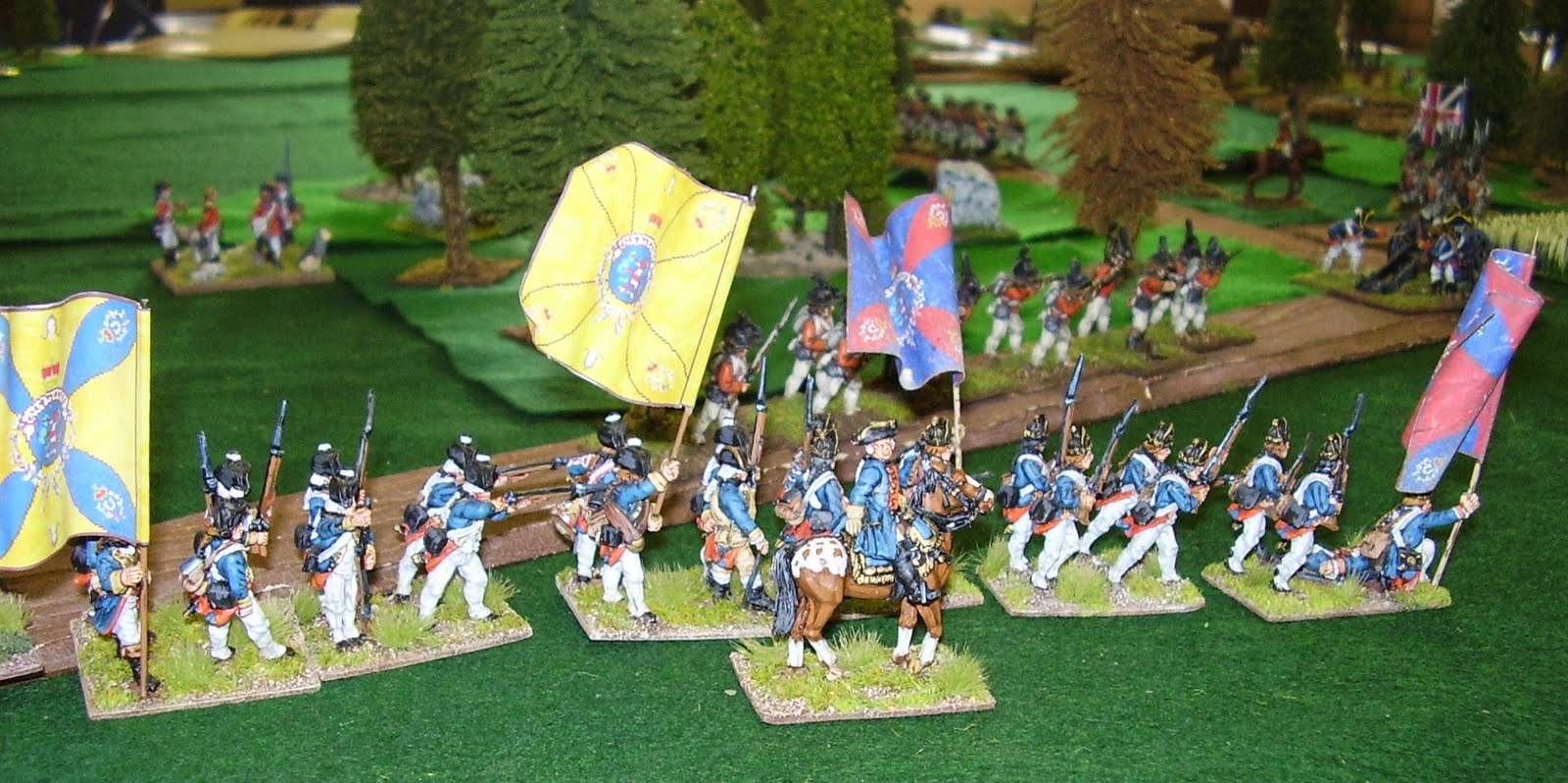
A few belated piccies from AWI Blackpowder game (thanks Ade)

Awaiting the redcoats arrival.


The American Second Line take up position


"Down with King George"

They may not be able to shoot very well but they're damned good at fencing.


American skirmishers skulking in woods.


American Second Line falls back


British press forward.


Continentals defend the town


......and the road


Friday, 30 July 2010

Black Powder III

.... and the irony is that we have the prettiest table ever and I forget the camera.

Imagine a verdant green sward of teddy bear fur
, bespoked clumps of birch and beech, snake fences, rocky outcrops, cornfields and a delightful Virginia town.

With a scenario loosely based on Guilford Courthouse the British/German force consisted of a dozen line and guard batallions, a couple of cannon and four skirmish units including one of injuns. These were divided into four brigades. Two in the first line and two immediately behind.

The American force was fifty percent larger and had the advantage of three distinct defensive lines including the ultimate goal of the town. However twelve of the rebel units were militia with poor or very poor morale.

We began with a brigade of North Carolina Militia, of four units, behind a snake fence a couple of feet from the British end of the eight foot table. British skirmishers began in range of the yankees (8" using the 2/3 movement scale). The Militia's opening fire was poor - having no effect upon the redcoats. On the British turn the majority of the advance brigades moved into long range and opened fire, adding a dice for first volley. A half a dozen hits - all but one saved by the lucky militia! With the militia's poor morale they required sixes to save; it must be noted that this was done with Adrian's blue dice (and we all thought they had no sixes on them).

On the right the Hessian's were finding it difficult to move forward but a British cannon laid low a regiment of mounted dragoons with one fine salvo of grape and the unit of indians was sent through the woods to outflank the second American Line. Their "bloodthirsty" bonus was used to good effect and they broke a militia batallion.

On the left the second British brigade were advancing smartly forward towards the second line of militia and were hit by a smart volley at long range by Kirwoods riflemen. A valiant charge however broke though the militia and the belt of wood and scrub into the open ground before the town. Similarly on the right the British-Hessian brigades proved too strong for the Virginians and they fell back towards the town to form a new line behind redoubts

However now the government forces were facing the cream of Greene's army, Maryland and Virginia Continentals. Firefights, charge and countercharge ensued but no breakthrough was made before we had to call it a day and the damned rebels claimed victory as they still held the town and pike road.

The first line of militia had proved very obstinate and while it was inevitable that they would break, the four moves it took cost the British too much time and while they were still relatively fresh at the end of the game the Continentals too had plenty of fight left in them.

Had we had time to continue for a couple or three more moves any victory would have been pyrrhic. A true reflection of 1781 when Cornwallis's tactical victory ultimately cost him his army.

Today's cheese was Jervaulx.

Sunday, 4 July 2010

Battle of Freeman's Farm


Washington ponders the news that the British are a coming.


Another attempt at the Black Powder rules.

We took the scenario from the Black Powder book but as we were using half size units
we adopted the 2/3 movement and range play sheet (thanks Jeff).

The British/German army had a couple more battalions than the Rebels and also four guns whilst the American's had none. Moreover the British troops were deemed to be "steady" and "crack", effectively enhanced morale.


Initial dispositions had the first British brigade (Hamilton's) marching along the road and a picket were wandering over to have a peek at the farm and woods. No pesky rebels in sight. The Brits get to move first, in theory, as a throw of 11 on Command prevents Hamilton's brigade from moving. The second Brigade however marches onto the table and along the road. The picket is (not very) surprised to be fired on from the woods as Morgan's brigade reveal themselves.


(piccies look better when enlarged than shown here)

With an excellent Command throw Poor's Brigade of Rebels advance between the farm and woods to Morgan's left hoping to reach the stream before the British.


The second British Brigade, Fraser's, enter the table in column of march with a skirmish line of injuns covering their right. In the centre the pickets engage Morgan's brigade in a long range firefight and Hamilton manages to bring one battalion forward before another Command failure.

Fraser manages to advance (slowly) on the right but in the centre Hamilton manages to turn column into line but then fails to advance following two Command Failures. The Yanks however pour forth along woodland paths and find an excellent defensive position with stream in front and between woods and farm.


Eventually the Germans arrive following Fraser along the road. Two excellent command throws see them in line and pouring fire into the rebels while the British continue with poor Command throws and struggle into battle line. The Picket and the lone batallion in the firefight with the American right are routed but the Americans hold their line.


The Americans have an excellent defensive position behind the stream and although this deters the charge with cold steel the British/ German firepower enhanced with artillery is proving superior. The "steady" and "crack" rules prove invaluable to the Brits in the firefight. Eventually the poor morale of the Americans begins to tell and they begin to withdraw.

Regimental mascot assists in British interrogation of a captured rebel.


The result was pretty much as that played out by the authors of the rule book and given the breakdown of the armies seems alomost inevitable. Given the poor Command thorws of the Brits more agressive tactics could have paid off for the Americans. However given the poorer troop morale levels and the excellent defensive position on offer it would have been a very brave and fortunate commander who could beat the British in this scenario.

Regimental mascot eats colonel's tricorn!


Washington ponders defeat with faithful friend.

The game started off quite slowly as we tried to get to grips with the rules again. While they are a good read they are not the easiest to pick out the relevant bits.
I want to like these rules but I'm not yet sure if we'll persevere. As players we make enough mistakes so do we need to be slowed down even more with Command rules. The argument is that this is realistic. Firstly how realistic is it that a brigade of professional British soldiers of 1777 would not be able to deploy in time to participate in a fight with rebels a few hundred yards away. The fact that we all know an example or two proves how rare this was. Secondly I play for fun not for a faithful reenactment of warfare.
Otherwise I like the mechanics of the rules and if we used them more then I think we would get used to the special rules such as "crack", "steady", "marauders", "blodthirsty", etc etc.
The self inflicted problem is that we never play the same rules two games running and rarely play the same rules two or three times a year. This tends to mean we go for the simple rather than the detailed. Mmmmm watch this space.
Todays cheese was Vignotte.

Sunday, 20 June 2010

Rossbach Revisited

It's always difficult to wargame a military disaster because rarely will a player make the same mistakes or the strategic situation be contrived.

I have had a French 15mm SYW army for a while and we have a enjoyed a number of interesting western theatre games. However when Richard put together a nice Prussian force there was one battle we had to get out of the way.


French and Reichsarmee cavalry advance with confidence


Following the disastrous summer (for Frederick) of 1757, which saw the Prussians defeated at Kolin and Gross-Jagersdorf, the French decided to have a go at the bluecoats and a motley mix of French, German and Austrian troops headed for Berlin. Heavily outnumbered Frederick repeatedly tried to manoeuvre himself into a decent defensive position but Prince Soubise was not too enamoured with the idea of a frontal attack into the teeth of Prussian musketry.

On 5 November Frederick deployed in another nice position on a ridge between two villages. With lines of communication stretched Soubise was keen to get to grips with an enemy force he esimated to be half the size of his own army. He decided on a enveloping manoeuvre to get around the flank and rear of the Prussians in four great columns. However the ponderous movement was observed by the Prussians who, concealed by the heights, swiftly about faced and redeployed. A devastating cavalry charge swept away the allied horse before it could properly deploy and the Prussian infantry and artillery made short shrift of the enemy foot. In an hour and a half the Allies had lost eight thousand men and their army was shattered. The Prussians lost a few hundred.

We set up a 6 foot by 4 foot table covered with Richard's effective teddy bear fur terrain mat.

The Prussians set up in three lines, two feet away from one short edge of the table stretching from one long edge, on the village of Brauesdorf, two feet across to the centre of the table and Rossbach village and a wooded area. This was the extent of one short side of the ridge.


Unfortunately the camera's batteries went after this piccie.
Columns of Reichsarmee outflank the Prussians on the ridge
As umpire I was fortunate in having the perfect Prince Soubise. I guessed correctly that Adrian, our resident Ancient's expert, may not be familiar with this C18 battle and also that being a nice chap wouldn't be too upset at being set up. No doubt he smelled a rat but saw the idea wasn't too bad on paper.
The contrivance sat with the Prussians, who I gave the opportunity of having a double move in any one of the first three moves. As we were playing Volley and Bayonet this could give the heavy cavalry a forty inch move!
Having the first move the Allies probably assumed that the outflanking manouvre was reasonable and charged their cavalry ahead in an attempt to reach the hill before the Prussians could redeploy. The bluecoats shuffled around in apparent disarray for two moves but on the third, just as the Allied horse reached the foot of the hills General Seydlitz unleashed his Cuirassiers and Dragoons down the slope with their double move.
Using the follow up amendments we have adopted for SYW Volley and Bayonet and Adrian's ability to throw badly on all occasions the Allied horse first column was pretty much wiped out in the third move.
Doggedly Soubise began to deploy his foot into reasonable order. At this point there was a cavalry reserve to arrive and the Prussians were still heavily outnumbered. However this Prussian army was possibly the most highly trained force the western world had seen since the Romans. In the next two moves their better morale ratings proved too much for the Allies and effectively the game was over as the French commands became exhausted. They had no choice but to withdraw, fortunately the Prussian horse was also exhausted and no great damage could be inflicted on the retreating force.
As umpire I was pleased with the recreation of a battle I have been fascinated by since reading Duffy's Army Of Frederick the Great. The result was never in doubt but the timing of Richard's use of the double move was crucial and Adrian played the role of Soubise perfectly, throwing a one in all the right places (sorry Ade).
Today's cheese was Reblochon


Saturday, 19 June 2010

Life stopped play, for a while


Real life has tended to interrupt playtime quite a bit over the last couple of months; but I did manage to complete the regiment I was speedily painting in the last post. Moreover I have managed another unit as well.

With the three feet rule I've spent about ten hours actual work on each unit.

While the painting may leave a lot to be desired I have to say how please I am with the Zvezda figures. Very nicely sculpted in realistic proportions with no flash and few (if any) wasted figures in a box.

I wondered weather the magic wash would have any effect on plastic figures as they don't have the exagerated folds and creases found on most 28mm. After a little experimentation however it did create a very pleasant effect. One drawback I found was that it dissolved the black ink I used on the gaiter garters (rotring pen) - black paint henceforth.

I used a black wash all over the first regiment which was okay, but on the second I used a blue wash on the light blue coat and clear over the gaiters and head. I had already put a brown wash over the face. The blue wash was much more effective.

On the shelf is a half painted dragoon regiment for L'Armee de Fromagere.