Sunday, 30 June 2013

Summer Campaign 1735

After much deliberation including visits to the tomes of Bath and Featherstone, I have decided to KISS. Keep it simple stupid. I add things up all day at work so I have decided against a book keeping type of campaign.

So almost back to the original plan, but I am going with a campaign tree based on a number of choices from Scenarios for Wargamers. The idea is the that the next battle will be the sort of scenario expected from the result of the one just fought. This won't give the unexpected twists and turns but that's difficult playing by oneself. The aim is to have a simple game of soldiers without too much thought involved and to work out the simplest possible set of rules that give a feel for C18 battles.

We start with Chance Encounter. Which will be followed by Holding Position no matter who wins.

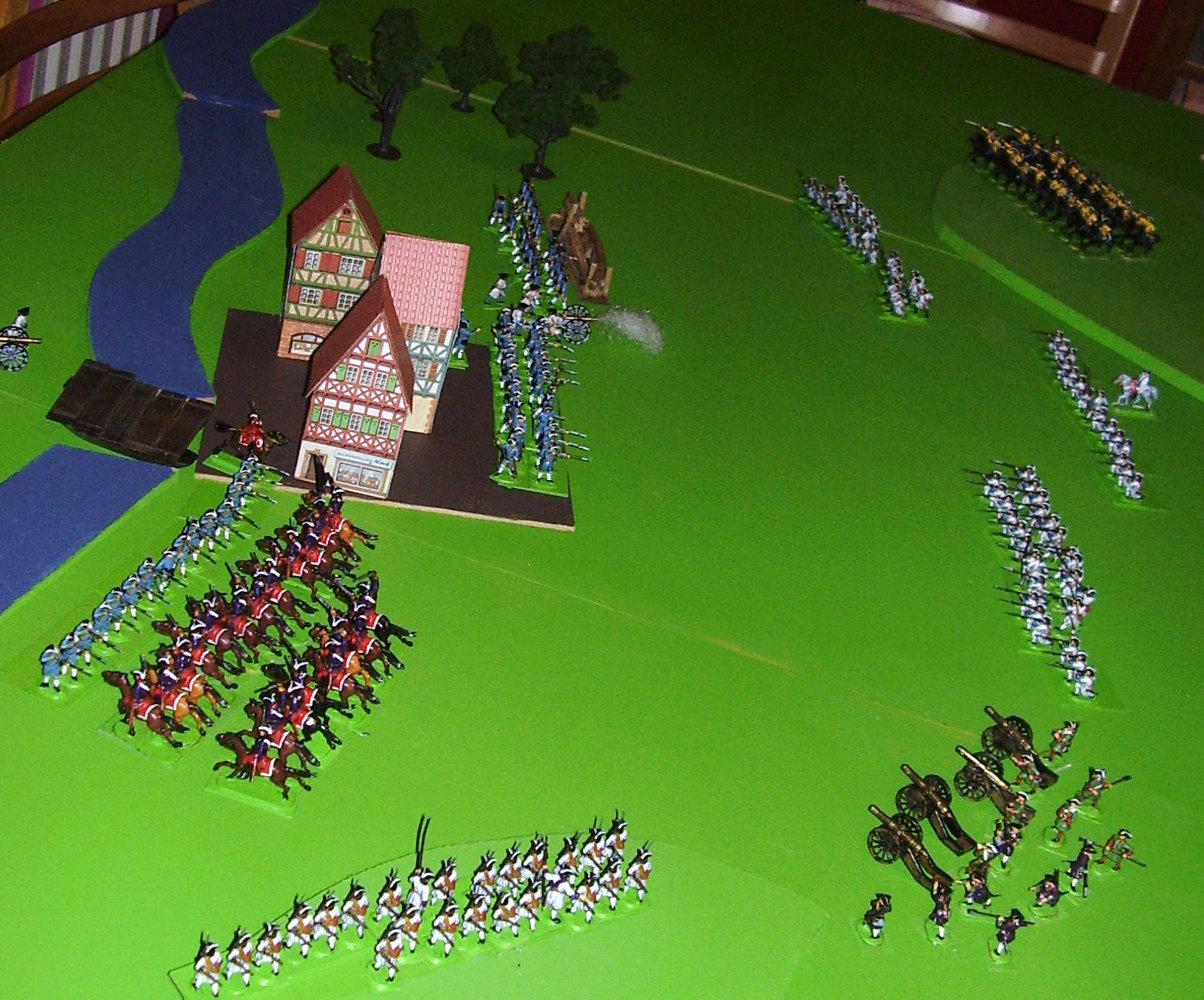
So the table is set and off we will go.


Sunday, 2 June 2013

Plans for new table

Just back from a fun weekend in Cardiff which hosted the British Speedway Grand Prix again. A great event in a lovely city. Great fun with speedway fans from all over the world, but can those Polish lads drink!

So not had time to take advantage of the new battlefield in the shed. Just 6 feet by four feet of mdf it takes up half the avaiable space but leaves plenty of room for a comfy chair and a shelf on which currently sits a large glass of merlot. Figures and terrain sit underneath.  I no longer have to clear the dining table and I'll be able to leave a part completed game on table. It's also painted a nice desert sand colour on the reverse side should the need arise.


The short term plan is to revisit Scenarios for Wargamers by CS Grant. The book suggests a table size of 7' by 5' but my units of thirty infantrymen have a frontage of about eight inches, less than two thirds that of Brigadier Grant's fifty four man battalions so there should be no problem there.

I have chosen a dozen suitable scenarios from the book and rather than have campaign tree each scenario will be randomly chosen with the throw of a D12. The army that wins three games in a row wins the "campaign" and will no doubt erect a suitable monument and produce an ostentatious medal.

I think the loser of a game will become the defender or the side with fewer units in the following game but I may have to think about this.

Rules will be my one brain cell old school rules based on The Wargame and Charge!

Thursday, 30 May 2013

Spring Projects

... any way HOTE was great fun and will be returned to. However DBA for the seven years war proved to be less successful. Too much back and forth to my eyes so it will be be a return to square one, which was a pretty fun square as I recall.

Enough of things square: the past few weeks have been a bit hectic at work, as well the Old Duchess turning 50, but I have squeezed in a couple of little projects a la wargame.

I have found that the only way to get painting is to decide to play a game for which I do not possess the figures. So in the four weeks between discussing to revisit Crossfire, the WW2 game guaranteed to give a headache, I had to get a battalion of French painted up to repel the damned Bosch.


Mostly Forged in Battle with Peter Pig I sloshed on the washes and good old Vallejo sepia shade.


At arms length, and with my myopic vision, they'll do a job, and of course won't be on table too long.


These guys show off their "suppressed" marker of which the French require an awful lot.


Needless to say the French did not do particularly well against their grey coated foe and were, in fact, well hammered. And yes the rules gave me a headache. Not because of their complexity for they are quite simple but, as it was for sergeant le Blanc in 1940, every decision is important and mistakes can mean disaster for one's platoon. Oh the stress of throwing a dice!

Secondly I have put away the squared board for the moment as the spring sunshine (ironic smile) has led me to clear out the old shed and I have erected a small but perfectly formed wargames table on which I can return to Fromagere in the not too distant future. A blast of trumpets and 21 gun salute!!!!!!!!!! Hurrah!!!


A range stick awaits the arrival of the Duc de Fromage.


Friday, 29 March 2013

DB Distraction

I had intended to try out a DB variant for my coffee table trip through the battles of Frederick the Great.

Not having played DBAnything for many years I was new to the DB treasure trove that is http://fanaticus.org and immediately was sidetracked by Hordes of the Empire (HOTE).

I pulled the Sudan box from the attic and had a quick go.


Although using Mr Pigs figures based up for Patrol in the Sudan there was no problem adopting the DBA square rules for speeding up movement and aiding the frontage issues DBA can pose.


Using the points system of HOTE a couple of armies were quickly knocked together. Mostly hordes for the Mahdi but also three warbands and three shooters, with an artillery piece added.


Nothing too fancy, just a quick try of the rules, so an all out advance by the Mahdists was quickly brought to a halt by the fire of the Imperial forces and the 9th Hussars came round the flank. The Horses of Ansar are recycled at too slow a rate at the bottom table edge.


The Hussars flank the captured Krupps but made hard work of taking it.


 Poor command dice eventually cost the Mahdi the battle but it was a fun way to waste an hour.

I need to paint up a base or two of Mahdi cavalry to counter those hussars.

Sunday, 24 March 2013

Hohenfreidburg

I revisited Twilight of the Sun King rules for the next quick SYW squared rules. However I incorporated the morale test at various points in the turn sequence, for units under bombardment, wishing to charge home and as a reaction to friends routing. The close combat was however a competitive exercise rather than a morale test.

They worked okay but, yet again, not what I was after as they were just too slow and require too many markers.


Hohenfriedburg was a battle of two halves and given that the first half was a foregone conclusion I had a go at the second.  The Prussians lining up against the tardy Austrians, the right wing pursuing Saxons.


The "forgotten" super regiment of Bayreuth charge home.


.... and are repulsed. These Austrians have not read their Duffy!!!!!!!!

After an hour and half of fairly tedious dice throwing these rules are destined for the waste bin.

I have been reading with interest the blog http://18thcenturysojourn.blogspot.co.uk/  and DBA variants.

I'll give them a go.

Sunday, 10 February 2013

Mini Campaign II "Rear Guard"

The Duke de Fromagere had hoped, nay expected, to be enjoying the delights of his marriage to the Countess Wilhelimina by now but instead found himself sitting on an uncomfortable settle in the dreary tavern of the village of Seibert. It was, however, at least warm and dry which was more than could be said for he rest of his army that camped in the rain outside the village.

The defeat of his army at Elblingberg had been followed by a rapid retreat to the River Wein before the Weinpfalzers could rally and reinforce and turn defeat into disaster.

The Fromagere army had made their way to the Wein in good order and with minimal interference from the inadequate light forces of the Weinpfalzers. However the withdrawal stalled on the river side due to the loss of pontoons on the spring torrent and as the engineers and pontoniers toiled the enemy drew nearer. 

By early morning of the following day the cavalry began to clatter across the planks of the pontoon bridge followed by the slower ox drawn supply wagons. Through the misty dawn light however the pickets could make out the the advance columns of the Weinpfalz army marching down the hills less than a mile away. The Duke must stand and fight with the forces he has left rather than risk being caught crossing the bridge and hopefully evacuate the remaining forces overnight.


The Fusiliers de Brie take advantage of timber from the nearby wood to defend their position. 


Fromagere have but three battalions and three guns to hold back the Weinpfalz forces arrayed before them. If they can hold them back for just twelve moves they can withdraw in safety to fight another day.


Count Otto sees the right flank of the enemy as the weak point and sets up his two batteries on the hill. The bombardment begins.


After three moves the artillery has taken it's toll on the Roquefort Regiment and the Count orders an outflanking movement on the left by the Rieslings whilst the other gray coats advance along the line. The Dragon Blau are ordered to the left to follow up. In a couple of moves musketry replaces the roar of the "grand battery" which limbers up and advances too. 

The bluecoats behind the redoubt and in the village have enough cover to counter to numerical advantage of Weinpfalz but the Roqueforts fall understrength and begin to fall back. The artillery  piece tries to cover but is lost to a charge by the Rieling Regiment. And after much manoeuvring the Blue Dragoons charge into the withdrawing Roqueforts and ride them down.


The grand battery unlimbers and begins to shell the village. The Fusiliers de Brie withdraw from the redoubts and take cover in the village with the second Roquefort battalion. Their combined musketry begin to take it's toll and in the centre the second Rieslings fall under strength and have to withdraw.

On move twelve the second Roqueforts fall under strength and would have to withdraw but night falls and the village and bridge are still held.

 The Duke wins the game but the campaign continues.


Tuesday, 29 January 2013


Being a bit of a geek I spend a lot of daydreaming time wondering about wargame rules in the never ending search for the perfect set. I have been pondering again the rules for the wars of wine and cheese and for the coffee table squares. When not day dreaming I like to read about wargames and battles (like most of us).

Late spring of 1745 saw a couple of very interesting battles for the wargamer, Fontenoy and Hohendfreiburg. I was looking through Duffy’s “Frederick the Great – a military life” as Hohenfreidburg is the next battle in line for the coffee table series and then found myself skimming through “Wargaming in Hisory vol 2”; the chapter on Fontenoy.

One particularly interesting part of the Fontenoy is where the column of British & Hanoverian infantry have advanced and shattered the awaiting French infantry with devastating musketry and are charged by 30 squadrons of cavalry. The first line of horse is driven back by steady volleys and are replaced by a second line who in their turn charge and are driven back, some squadrons charging eight times to no avail.

I think my rules would probably reflect this giving steady infantry a definite advantage over cavalry charging head on.

 However a month later and much further east Lieutenant Chasot wrote of his experience with the Bayreuth Dragoons at Hohenfreidburg. “…we broke into a trot and finally a full gallop, putting our heads down and running into the Austrian grenadiers. They at first stood and delivered a volley at twenty paces, after which they were overthrown and mostly cut down.”

My rules would allow for this if the volley was ineffective but Duffy writes of the ensuing mayhem – “Behind the grenadiers the Bayreuth Dragoons collided with main force of the Austrian infantry.  In twenty minutes the regiment took five cannon, sixty seven colours and 2,500 prisoners, losing just 94 men in the process.”

Were the Bayreuth regiment so much better than the French at Fontenoy? Were the British just more effective at firing? Was it a matter of panic amongst the Austrians and how to reflect this possibility in a game.

It’s back to the palimpsest that are my rules to determine how to legislate for such differing results of cavalry charging infantry in the mid C18.